Kraken’s Krak app opened a U.S. waitlist on November 24 for a credit card that pays rewards in dollars or bitcoin. The headline offer is up to 4 percent cashback, but the rate depends on the amount a customer keeps in a Krak account. Access also requires a paid Krakpass subscription. The announcement describes an upcoming product and does not establish that cards have begun shipping.
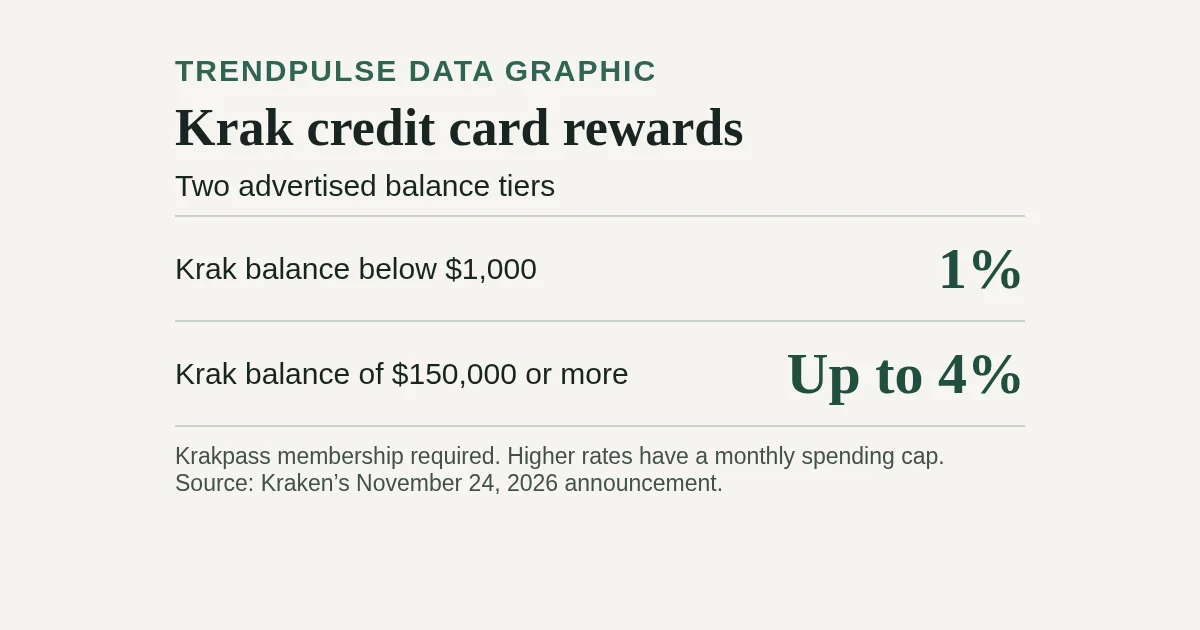
The two ends of the reward schedule show how differently the offer can work across accounts. Kraken said balances under $1,000 start at 1 percent cashback, while balances of $150,000 or more can qualify for the highest rate. According to the company, the 3, 3.5 and 4 percent rates apply to the first $10,000 in eligible purchases each month. Additional eligible spending earns 2 percent for those tiers. The reported top rate is therefore both balance-dependent and subject to a spending cap.
Krakpass was listed at $6.99 monthly or $75.48 annually in the announcement. That fee is separate from the rewards paid by the card. Choosing to receive rewards in bitcoin also changes what happens after the reward arrives. A dollar reward stays denominated in dollars. A bitcoin reward can be worth more or less in dollars if the market price changes. The payment choice does not change the published thresholds for reaching a higher rewards tier.
There is also a distinction between the standard card in Kraken’s public announcement and the broader rollout reported by The Block. The outlet said Payward, Kraken’s parent, plans a standard credit card and a secured version under the Krak name. The secured version would allow USDC to be pledged as collateral, the outlet reported, citing material shared by the company. Pledging an asset as collateral ties it to the credit arrangement. It is a different feature from receiving a reward after making a purchase.
The timing remains unclear. Kraken’s announcement said it expected shipping in late 2026. The Block reported that the cards were expected to begin shipping in early 2027. These are separate published expectations, and neither source confirms an actual shipping date. Joining the waitlist signals interest. The final timetable and the terms attached to an individual account will become clearer when the card is issued.
The announcement points to a broader question about financial apps that link card rewards to the size of a customer’s account. A single cashback number is easy to compare across products, but it leaves out what a customer must do to earn it. Here, the cost of membership, the amount held in Krak, and the monthly spending cap are all part of the offer. The two examples in the chart show the ends of the advertised scale rather than a complete schedule of rates.
What remains to watch is when Krak starts issuing cards, whether the same timetable applies to both versions, and what protections and conditions appear in the final agreements. Until then, the waitlist and advertised reward structure are the confirmed developments.
Corrections: Any substantive correction will be noted here.